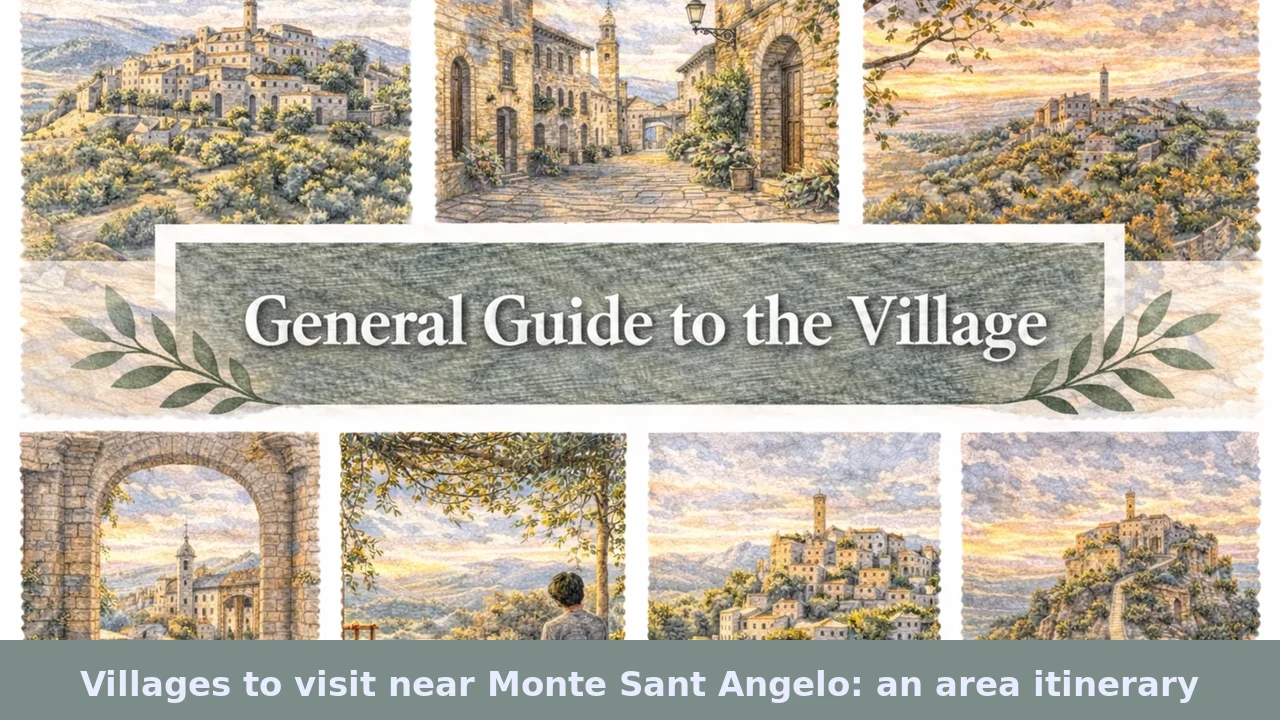
If you’re planning a trip to the Gargano and wondering which borghi vicino a monte sant angelo are worth a detour, get ready to be left breathless. This corner of Puglia, perched between sky and sea, holds a cluster of towns where time seems to move at its own pace — slow, generous, scented with wood-fired bread and pine resin. Monte Sant’Angelo is the perfect starting point, but the real beauty lies in what unfolds around it, along roads that wind through olive groves and ancient forests.
Before exploring the surroundings, it’s worth understanding why this village represents such a powerful centre of gravity for the entire area. Monte Sant’Angelo is one of the oldest pilgrimage destinations in Europe: its Sanctuary of Saint Michael the Archangel, inscribed on the UNESCO World Heritage List, has been drawing visitors and the faithful for over fifteen centuries. The sacred grotto where, according to tradition, the Archangel appeared in 490 AD is a place that takes the breath away even from the least devout — a dense silence, walls of living rock, the dim glow of candles.
But Monte Sant’Angelo is not just about spirituality. The Rione Junno, with its white houses stacked one upon another like a natural nativity scene, tells centuries of popular life. The Norman-Swabian-Aragonese Castle commands the panorama from above, and tucked into the alleyways you’ll find shops selling the famous ostie ripiene, a local sweet you won’t find anywhere else in the world. For those who wish to delve deeper into the history of the sanctuary and the UNESCO site, the dedicated page on the official UNESCO website offers a detailed overview.
The Gargano and the Daunian Sub-Apennines are dotted with villages that look as though they were painted on canvases from another century. Here is an itinerary that starts from Monte Sant’Angelo and fans out towards the Puglian hinterland, touching places rarely reached by mass tourism yet brimming with character.
Heading up towards the Daunian Mountains, about an hour and a half by car from Monte Sant’Angelo, you reach Alberona, a village that seems suspended between clouds and oak woods. Listed among the Most Beautiful Villages in Italy, this tiny settlement of just over a thousand souls preserves a medieval tower linked to the presence of the Knights Templar and a monumental fountain — the Fontana Muta — which, according to legend, stopped flowing the day the Templars were suppressed.
The historic centre is a maze of narrow stone lanes, with sudden views opening onto the Tavoliere valley. In summer, the cool air at its 732 metres of altitude makes it a perfect refuge from the Puglian heat. Don’t leave without tasting the cicatelli with wild boar ragù at the trattorias in the centre.
Continuing along the ridge of the Daunian Mountains, Castelnuovo della Daunia welcomes visitors with the unmistakable profile of its main church and the remains of an urban layout that has kept its medieval plan fully intact. The village is small, compact, silent — one of those places where you hear your own footsteps echoing on the cobblestones and the trickle of water from some hidden fountain.
Here the charm lies in simplicity: carved stone doorways, wrought-iron balconies laden with geraniums, elderly locals chatting on chairs outside their front doors just as they did fifty years ago. It is a perfect spot for anyone seeking pure authenticity, far from any tourist showcase. The surrounding countryside, stretching between wheat fields and olive trees, offers walks and views of rare beauty.
Rounding off the itinerary, Orsara di Puglia is perhaps the village that best captures the soul of the Daunian Mountains. Famous for the night of the Fucacoste e Cocce Priatorje — the local All Saints’ Eve tradition of lighting bonfires and carving pumpkins long before Halloween became fashionable — Orsara is a place of deep-rooted traditions and a surprisingly rich food culture.
The town is home to restaurants that have elevated Daunian cuisine to outstanding levels, and its wineries produce indigenous wines that deserve a proper tasting. The Abbey of the Angel, with its grotto of Saint Michael, creates a direct thread with Monte Sant’Angelo and the Michaelic cult that runs through the entire Gargano and Sub-Apennine area.
To make the most of this route through the villages, here are some useful pointers:
For a deeper look at the region and its tourism resources, the official Puglia tourism portal is an excellent resource for planning your stops.
What makes an itinerary through the borghi vicino a Monte Sant Angelo so special is the constant sense of discovery. These are not museified places or reconstructions built for tourists: here life still flows according to ancient rhythms, and every stone, every doorway, every plate of handmade pasta tells a true story. From the mysticism of the Archangel’s grotto to the bonfires of Orsara, from the Templar silence of Alberona to the boundless countryside of Castelnuovo della Daunia, this corner of Puglia offers a rare and deeply rewarding travel experience.
If you want to start planning your visit and discover everything Monte Sant’Angelo has to offer — from historical attractions to tips on where to eat and sleep — visit the full guide dedicated to Monte Sant’Angelo on VillagesItaly: you’ll find all the up-to-date information you need to organise your trip to the heart of the Gargano.