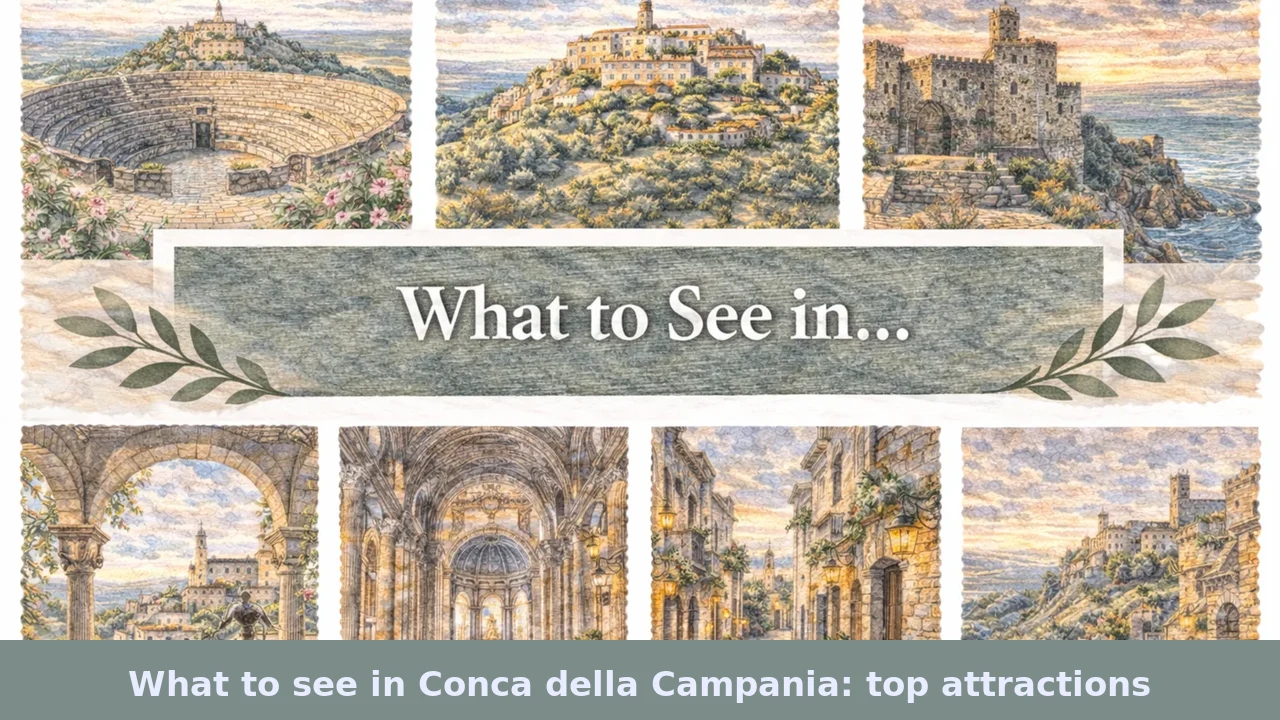
If you’re looking for what to see in Conca della Campania, get ready to uncover a corner of Campania that very few people truly know. We’re in the upper province of Caserta, on the border with Molise, where hills chase one another through olive groves, oak woods and silences steeped in antiquity. Conca della Campania is one of those villages you won’t find in glossy guidebooks, yet it holds treasures capable of surprising you: churches that tell centuries of faith, panoramic views that take your breath away and a timeless atmosphere that, once experienced, is not easily forgotten.
The best way to begin your visit is to get lost — in the best possible sense — among the alleyways of the historic centre. The narrow lanes, the doorways carved from local stone, the staircases worn smooth by generations of footsteps: everything here speaks of a community that lived and built with patience, stone upon stone. Don’t expect tourist signs at every corner. The beauty of Conca della Campania lies precisely in its authenticity, in the fact that every discovery feels like an unexpected gift.
Walking towards the upper part of the village, you’ll notice how the houses lean against one another, creating a compact and fascinating urban fabric typical of the medieval inland settlements of Campania. Stop now and then and look up: the outlines of the surrounding mountains provide a natural frame for a landscape that changes colour with the seasons.
Every Italian village has its mother church, and Conca della Campania is no exception. Standing in the heart of the settlement, it serves as both the spiritual and architectural focal point of the community. The façade, understated yet dignified, leads into an interior that preserves fine decorative elements, including stucco altars and devotional canvases that bear witness to the artistic vitality of this area over the centuries.
Why visit: beyond its religious significance, the church offers a window into local history. Every side chapel, every wooden statue tells a piece of community life. Access is generally free during daylight hours, but in the winter months it’s worth checking opening times with the parish.
One of the most fascinating aspects of this territory is the presence of small chapels and rural churches scattered across the surrounding countryside. These buildings, often modest in size, form a devotional network that once linked the village to the fields, the shepherds and the farmers. Some date back to the medieval period and still bear traces of frescoes that, though faded by time, retain an extraordinary charm.
Among these, the votive chapels encountered along the paths connecting Conca della Campania to its outlying hamlets deserve particular attention. They are not always open, but even from the outside they tell a story of popular faith deeply rooted in the landscape.
A short distance from the town centre stands the Sanctuary dedicated to the Madonna della Libera, a place of devotion especially dear to the local community. It is a pilgrimage destination above all during the feast days devoted to the Virgin, when the village comes alive with processions, hymns and traditions that reach back into distant times.
Why it’s worth a visit: the sanctuary is not only a place of prayer but also a remarkable viewpoint. From here the eye sweeps across the valley below, embracing a green, undulating horizon that, on clear days, delivers genuinely moving moments. Access is free, and the site is particularly suited to a late-afternoon visit, when the golden light transforms the landscape.
Conca della Campania owes part of its name to the shape of the land: the village sits in a kind of natural basin, surrounded by hills and mountains that create a landscape amphitheatre of rare beauty. Viewpoints are plentiful, and you don’t need precise directions — just walk a little beyond the last houses of the village to find yourself before vistas that would deserve a postcard.
This area of the upper Caserta province, still largely untouched by mass tourism, belongs to a cluster of villages of extraordinary interest. If you have time, I recommend venturing as far as Ailano, a nearby village set in a similar landscape and equally rich in history, or heading towards Ciorlano, another hidden gem of this province that holds surprises at every turn.
Like many inland villages of Campania, Conca della Campania preserves traces of its feudal past. Carved doorways, fragments of walls, noble palaces with coats of arms above the lintels: details you discover by strolling unhurriedly and with an attentive eye. There is no structured museum trail, and perhaps that is precisely the charm — here, history is read directly from the stones.
To explore the historical and geographical context of the area in greater depth, it may be helpful to consult the Wikipedia page dedicated to Conca della Campania, which provides a general overview of the municipality and its hamlets.
Visiting Conca della Campania also means coming into contact with a genuine food culture and traditions handed down from generation to generation. The extra-virgin olive oil produced in the area is of excellent quality, as are the cheeses and artisanal cured meats. If you happen to be here during a patron saint’s feast or a food festival, don’t miss the chance to sit at a communal table and taste the dishes of local tradition: homemade pasta, legume soups, grilled meats.
For up-to-date information on events and cultural initiatives in the province, the Province of Caserta website can be a useful point of reference.
Conca della Campania is one of those places that gives back far more than you might expect. It doesn’t have the fame of more celebrated villages, but for that very reason it offers an authentic experience, far from the hustle and close to the truest essence of travel. If this account has piqued your curiosity, I invite you to visit the full profile of Conca della Campania on Villages Italy, where you’ll find all the information you need to plan your visit and uncover every detail of this splendid village in the upper Caserta province. Set off, explore, let yourself be surprised: Conca della Campania is waiting for you.